Sexual Abuse, Security, and the Seal of Confession

A reflection by Sarah

Over the past few days, a couple of news items have led me to reflect more on my experiences as a survivor of sexual abuse. Scrolling through my Facebook feed this week, I’ve encountered an array of discussions about whether a priest should ever be permitted to violate the seal of confession. On Sunday, I came across an article discussing the Anglican Church in Australia and its newly authorized amendment to a canon on the seal of confession. The decision, subject to acceptance by individual dioceses, authorizes priests to disclose the contents of confessions in cases of serious crimes. Then yesterday, I stumbled upon another article about a Roman Catholic priest, Father Jeff Bayhi in Louisiana who is being sued by a family. The family claimed in 2009 that their preteen daughter revealed to Fr. Bayhi in confession that she was being sexually abused, and he had instructed the girl not to report the abuse. The canon law of the Roman Catholic Church prevents priests from even disclosing whether a particular person has had a confession, so it is impossible to verify the family’s claim. The Louisiana Supreme Court ruled that Fr. Bayhi is required to testify about the confession, but he refuses to do so because of religious obligation. I have been following both of these stories and have seen a wide range of reactions. Some people praise the Anglican Church for becoming more transparent while accusing the Roman Catholic Church of doing nothing more than covering up abuses. On the flip side, many people are horrified by the Anglican Church’s decision while praising Fr. Bayhi and the Diocese of Baton Rouge for their commitment to upholding the seal of confession.

I belong to a Christian tradition where confession is offered, and it is encouraged that people make confessions as often as needed. Confession is, without a doubt, one of the most meaningful spiritual practices in my life. Every good confession makes me feel like a newly-illumined handmaiden all over again. Forgiveness is the most incredible of gifts. Each experience of this mystery leaves me feeling washed, renewed, restored, made whole, joyous, grateful, and empowered. At times, going to confession has brought me out of dark depressive episodes. It reminds me that I am a fallible human being, I am far from perfect, I cannot heal myself, and I need the prayers and support of the Church as I journey towards Christ. Sin, repentance, and forgiveness do not happen in a vacuum where it’s just me and Jesus. When I experience a good confession, I leave feeling refreshed by God’s grace and goodness, humbled by my human frailty, and overwhelmed by God’s willingness to share my humanity as much as Christ shares in the humanity of every person. Confession is a great equalizer among people. When we come in repentance, we all strive to humble ourselves to receive God’s grace as fully as possible. In confession, everyone is a sinner.

There are times when I can’t help but remember myself as a 12-year-old experiencing sexual abuse at the hands of a member of my childhood faith community. I did not reveal my abuse in the context of a sacramental confession. I remember that when I first told my parents about the abuse at age 14, they refused to believe that I might be telling the truth. Eventually, I learned that other people in my faith community knew this man was an abuser and likely even knew that I was among his victims. However, no one did or said anything to stop him or to make my parents aware that a very real danger was lurking in the pews. As a teenager, I spent many a night lying in bed, muffling the sound of my sobs because the two people I had told about the abuse didn’t believe me (until some time later) and no one else seemed willing to do anything to help. In those moments, I prayed continually that someone would eventually say something.

In my early twenties, I started dealing with the emotional aftermath of my abuse. Working through my trauma with therapists has been a critical part of my healing process. But unlike priests who are committed to upholding the seal of confession, therapists don’t hesitate to break confidentiality in certain circumstances. They are required by law to disclose if a person is a danger to himself/herself or others. Early on in my attempts at help-seeking, I struggled to find the boundary regarding what I could honestly share with a therapist that wouldn’t lead to a response of, “I’ll have to break confidentiality.” As I began to navigate the world of mental healthcare, I wondered, would it ever be safe to share if I was feeling slightly suicidal but with no real intent to act? What would happen if, in a burst of emotional processing, I were to blurt out, “I’m so angry that I could kill (a person)!”? I was also uncertain of what would happened if I would ever disclose more specifics about my abuse, making clear that it had occurred in childhood. Once, I had a therapist at an eating disorder treatment facility tell me that, as a mandated reporter, he had to report my abuse because it had not been reported previously. It didn’t seem to matter that I was 22 at the time I was seeing him, or that the abuse had happened years before and in a different state. I found out later that he had misinterpreted the law, but nonetheless his response to my disclosure removed any agency I might have had in deciding whether or not to report the abuse myself. I couldn’t shake the feeling that I had been duped; I lost confidence in this person’s commitment to keeping any part of my story confidential despite the almost-total guarantee that what one says in therapy remains private.

I have always been glad that priests and therapists follow different standards. I find it tremendously reassuring that a priest must hold my sacramental confessions in complete confidence. Because of the seal of confession, I feel safe in ridding my closet of every possible skeleton, disclosing the worst of the worst, and opening myself completely for God to heal my brokenness. In confession, I experience an abiding freedom to admit all of the times I have murdered my parents in my heart because they failed to protect and believe me. I have reconnected with my humanity as I can admit to the terrible ways I have abused my own body through eating disorder behaviors, alcohol, and drugs. I have sought reconciliation after so many instances of harming others and myself. I have been able to confess to God parts of my past that are so dark I would never dream of sharing them publicly. Such is the nature of confession. The seal of confession has been a part of Christian traditions for more than a thousand years. It gives us all an equal opportunity to unburden our souls, receive forgiveness from God, benefit from the prayers of the Church, and walk in a new way of life. In confession, the worst criminal imaginable is my equal, even though I have never killed, stolen from, or abused anyone.

If a priest were to break the seal of confession, that equality would be no more. As it stands, Christ waits at the door of the Church shouting, “Come all who wish to repent! Encounter God in the depths of divine mercy!” However, if priests all of a sudden began employing the same standards as therapists, the message would change. Few penitents would come to confession after hearing consistently, “Come all who wish to repent, but do know that there’s a chance you might be waking up the next morning in a jail cell or a hospital bed.” As much as my preteen self was dying for someone–anyone–to know what was happening to me and offer support and help, even if I had disclosed the abuse to a priest in confession I cannot see how breaking the seal would have been in my best interest. Quite the contrary: it would have robbed me of my sense of security within the safest place I’ve ever known. I would have been grateful to know that a religious leader was watching out for me or taking other measures to assess my safety that would not have involved breaking the seal. But I hope that in all circumstances, no matter how severe, priests in my Christian tradition will always honor the seal of confession. Whether I like it or not, my abuser needs God’s mercy and forgiveness as much as I do, and if he seeks it, I say let him. Christ did not come to save only those who have “minor” struggles with sin. Christ does not pour out mercy in a differential manner; He lavishes mercy on all. When Christ himself was dying on the cross, he offered forgiveness to the repentant thief dying next to him. If that action were not incredible enough, he also called out to his Father saying, “Father, forgive them for they do not know what they are doing,” inviting an extension of forgiveness to the very people who nailed him to the cross. Who am I to deny anyone, even my abuser, access to an opportunity to fall at the feet of Christ and ask forgiveness? As I see it, to advocate for a priest’s breaking the seal of confession is to risk denying someone an opportunity for forgiveness.

As I write this, I pray that people in all churches will become increasingly aware of child sexual abuse and other serious crimes, especially those that occur within the Church. I pray that Christian traditions will do everything they can to educate people about child sexual abuse and work diligently to prevent it from occurring. But when it comes to confession, if I had to face the possibility that my priest were on the lookout for the “worst” sins to determine whether to break the seal, I fear that I would never return to this mystery again. Christian traditions that offer sacramental confessions need priests who would face imprisonment, torture, or even death before the revealing the contents of any confession. One who fails to do so endangers the spiritual welfare of all who seek God’s forgiveness through this sacrament.

UPDATE: A friend kindly pointed out to me that if read in a certain way, this post could be taken as my advocating total inaction on the part of the priest when it comes to child sexual abuse being revealed within the context of sacramental confession. To clarify: that’s the last thing I’d ever want to see happen. In my opinion, any priest worth his salt would do everything possible to help the child in question without breaking the seal of confession. In the comments below, I’ve listed some things that my own priest friends have told me they would do if they were to find themselves in such a situation. As always, you can contact us with any questions, and respectful disagreement is welcome in the comment box.   -Sarah

Comment Policy: Please remember that we, and all others commenting on this blog, are people. Practice kindness. Practice generosity. Practice asking questions. Practice showing love. Practice being human. If your comment is rude, it will be deleted. If you are constantly negative, argumentative, or bullish, you will not be able to comment anymore. We are the sole moderators of the combox.
Speaking of Sexual Trauma

A reflection by Sarah

It’s never easy to talk about sexual trauma. No matter how often a related story appears within national, international, and local media, no matter what we’ve learned from child protection trainings, no matter how regularly we’re exposed to it in a culture saturated with sexually-charged messages, this is a topic that makes almost everyone uncomfortable. And that’s because most people haven’t the foggiest clue how to talk about it. I’ve been broaching the subject for years within my own circle of friends, slowly challenging my comfort zone, including more people in the discussion, and I still don’t know the best way to talk about it…especially within the context of LGBT issues.

Where I grew up in Eastern Kentucky, people didn’t talk about sex. It wasn’t considered appropriate for polite conversation. I came into puberty knowing virtually nothing about sexuality, and most of my peers weren’t much better off. And I’d venture a guess that almost no one–not even our parents–had any idea how to recognize the signs of sexual abuse. I was taught that sex offenders are suspicious, shadowy figures who lie in wait for children who wander away from their parents, that “good” people–especially those who are active in the local community and church–can never be predators, and that old men can’t be held accountable for sexual touching because they might be senile so their actions don’t count as abuse. My parents brought me up to believe that once I entered puberty, it was my responsibility to watch out for men who weren’t able to keep their hands to themselves. I simply had to understand that most of these men weren’t raised properly and might not be able to handle seeing a pretty girl who was beginning to develop at a younger age than average. If a man was a close friend of my parents, he certainly didn’t fall into this group. Any suggestion that such a person might be unsafe was categorically unbelievable. And most of all, if anything ever happened to me, I was never to tell a soul other than my parents–who would be the sole determiners of whether I was telling the truth–for fear of making waves in the community and gaining a reputation as a loose young woman. I was 23 years old and nearly overcome by PTSD before learning that everything I thought I knew about sexual abuse was a falsehood.

Central Appalachia is not the only area where such things happen, and I am not the only woman who has had such an experience. More to the point of today’s post, I’m not the only lesbian or the only member of the LGBT community who has survived sexual trauma. Yet we can’t seem to talk about it. It’s uncomfortable. It doesn’t sound nice. It could be used to discredit LGBT people. The discussion could be used to discredit liberals, or conservatives, or feminists, or anti-feminists, or affirmers, or non-affirmers. So on rare occasions when we do discuss LGBT survivors of sexual trauma, we’re good at building agenda-driven walls around the ways people are permitted to share their stories.

Yesterday morning, I was rereading our review of The Third Way. Specifically, I was reflecting on the story of sexual abuse shared by Julie, one of the documentary’s interviewees. Julie claims that her lesbian sexual orientation is linked to the fact that she endured sexual trauma as a young girl. She makes clear that after being abused, she began to view men as perpetrators and wanted nothing more to do with them. In our review, Lindsey and I discussed Julie’s story as one example of the film’s ex-gay undertones, and we stand by our criticism that overall, The Third Way privileges an ex-gay narrative while ignoring the diversity of celibate LGBT experiences. But regardless of the documentary’s shortcomings in piecing together a more comprehensive metanarrative, as an individual, Julie has a right tell to her own story as she understands it. She has lived it, and it would be absolutely unjust for me to say that I know it better than she does. It would also be unjust for another person to force me, or any other survivor, into Julie’s framework for understanding possible intersections of sexual orientation and trauma.

Speaking of sexual trauma as an LGBT person requires walking on eggshells. Our stories have political capital, whether we want them to or not. In my experience, the broader LGBT community expects survivors to defend the idea that sexual abuse rarely, if ever, is a determining factor in one’s sexual orientation. On the other extreme, most of the conservative Christian community is convinced beyond a shadow of a doubt that if an LGBT person was sexually abused at some point in life, surely that must be the cause of his or her sexual orientation.

A survivor with a story like Julie’s will inevitably face the criticism, “Your story is harmful to all other survivors in the LGBT community! Studies show that there are just as many straight women as lesbians who have histories of sexual trauma.” A survivor who is confident that his/her sexual trauma was not a causal factor for sexual orientation will face the opposite criticism: “You’re in denial. Prove that the abuse is unrelated to your orientation. Until there’s proof that sexual trauma never impacts sexual orientation, your story isn’t worth discussing.” Those of us who have chosen celibacy are accustomed to getting blasted equally from both sides, with conservative friends arguing that the trauma caused our gayness and liberal friends assuming that the trauma is our reason for being celibate. Not to mention that on top of these stigmas, we face all the same stereotypes and judgments (i.e. attention-seeking, it didn’t really happen if the perpetrator didn’t go to jail, we’re at fault) as do straight survivors.

Speaking of sexual trauma should not have to be re-traumatizing. Nor should it have to be like a multiple choice exam where you get 100% for bubbling in all the correct answers. I have no interest in being someone’s political pawn, whether inside or outside the Church. But I’m very interested in beginning a conversation about sexual trauma that invites all LGBT survivors to full participation. If you believe your sexual trauma is totally unrelated to your sexual orientation, if you see those two life experiences as completely intertwined, if you think the two might be related but you aren’t sure how and would like to explore further, or if you’ve never even considered the question before, we’d be honored if you felt safe to share more of your story with us.

It’s time for others to stop using narratives of sexual trauma in an effort to discredit LGBT survivors; it’s time for others to start listening to survivors telling their own stories. The last thing an LGBT survivor needs is to walk on more eggshells. The constant politicization of narratives regarding sexual abuse means that any LGBT survivor who opens up at all about his or her own story faces a loaded cannon of criticism. This post is our initial attempt at saying we’d like to change the tenor of the conversation. We’d like to foster a hospitable place here at A Queer Calling where survivors can know that all stories will be heard.

Comment Policy: Please remember that we, and all others commenting on this blog, are people. Practice kindness. Practice generosity. Practice asking questions. Practice showing love. Practice being human. If your comment is rude, it will be deleted. If you are constantly negative, argumentative, or bullish, you will not be able to comment anymore. We are the sole moderators of the combox.

The Obscuring of Orthodoxy (or, When Half-Truths Reign Supreme)

A reflection by Sarah

One day eleven years ago when I was a university freshman, some Christian friends and I decided to spend a Friday evening listening to a presentation about faith and human sexuality. We pooled our money for gasoline, piled into someone’s mother’s minivan, and began the two-hour drive to the church hosting the event. All my friends had heard fantastic reviews of the speaker. One had heard his presentation before and considered it near perfection, insofar as that’s possible for a human to achieve. She built up his image as nothing short of a living saint, and though I was skeptical of the high praises I found myself intrigued and ready to hear the message with an open mind and heart.

That evening, I sat in a folding chair on the floor of the parish school’s gymnasium, friends at my side, surrounded by two-hundred other young adults and teens. The speaker implored us to listen for the gentle voice of the Holy Spirit as true, theologically orthodox teaching was proclaimed. He was quite charismatic and used simple metaphors. He explained that God’s plan for human sexuality exists because of the great love our Creator has for us, and that using sexuality as God intended brings an exquisite sense of inner freedom and peace. Enamored gazes emerged from nearly all the girls when he posited that women have a special place in God’s plan, and a woman’s womb is like a tabernacle in that it bears new life into the world. His words painted a romantic landscape of what life looks like when one both believes in and practices a traditional sexual ethic, stating that settling for anything else is like voluntarily drinking contaminated water while having access to a fresh natural spring.

Then, the topic turned to homosexuality…and when it did, the speaker’s mannerisms changed entirely. He proclaimed boldly that homosexuals are confused people who accept comfortable lies instead of the truth, are incapable of seeing their true identities in Christ, and should not be admitted to the sacraments under any circumstances short of repentance for their ungodly identities. He rattled off a litany of statistics and claims that homosexual people are more likely to be pedophiles than heterosexual people, everyone experiencing same-sex attraction was molested during childhood, people choose and can change their sexual orientations, and those in same-sex relationships are unfit parents. At that point, I tuned out completely. “If this is what a traditional sexual ethic means,” I told myself, “I want nothing to do with it. This is nothing but hatred and stereotyping.”

Roll the video of my life forward a decade, and things look quite differently than my nineteen-year-old self imagined they would. But I think back on that presentation once every few months when I see conservative religious news headlines like, “Priest Speaks the Truth in Love at School Assembly; Parents Outraged” and “Pastor Persecuted for Upholding Biblical Teaching at Youth Convention.” In each of these articles the story gets pitched as an injustice: an innocent Christian who is doing nothing more than speaking the teachings of his or her faith gets the shaft because of liberal infidels who want to change the Church. Without fail, every internet combox fills with inane rants of, “We’re living in the last days. It’s time to stand up for morals, values, and the TRUTH of Church teaching!” and oppositely, “The homophobic, misogynistic ‘Church’ is a crumbling institution, and I can’t wait to watch it topple.” Then, I research the details of the stories, I read the conversations about them, and I think back to nearly every experience I’ve had with a speaker promoting a traditional sexual ethic. Why? Because in my estimation, the same problem exists among most conservative Christian presentations on human sexuality: questionable claims, flawed statistics, citations of studies employing faulty methodologies, demonizing stereotypes, a wee bit of valuable catechesis thrown in for good measure…and all of it presented under the banner of theological orthodoxy.

Faith and sexuality speakers claiming theological orthodoxy have a tough task ahead of them. They have set out to sell an unpopular product to a market where the majority of consumers are uninterested. There’s nothing easy about explaining the traditional Christian position on human sexuality to a generation of young people who have likely had far more exposure to an “anything goes” sexual ethic. I appreciate the difficulty of this task, and as a celibate LGBT Christian I believe it is important to discuss openly the reasons that some LGBT people choose celibacy, and the Church teachings that might inspire a person to make this decision. Some speakers–perhaps the minority–do this very well. But most of the time, I’m sorely disappointed in the messages I hear at these presentations with young people as their target audiences. Most of the time, at least in my experience, they’re not simply sharing the teachings of their faith. Intentionally or not, many of them offer misleading representations of homosexuality and intertwine the stereotypes with orthodox Christian doctrine such that most attendees will likely have trouble seeing the difference.

At various chastity and sexuality talks I’ve attended since my teen years, I’ve heard it stated as fact that people gay people choose to be gay, no one is born gay, and homosexuality is a psychological disorder. In reality, there are no conclusive scientific answers about the origin of a person’s sexual orientation, but several studies suggest that both genetic and non-genetic biological factors play a role. And according to the American Psychological Association homosexuality is not a psychological disorder, and most people have no (or little) choice regarding their own sexual orientations.

I’ve also heard speakers pronounce as fact that childhood sexual abuse is an automatic ticket to same-sex attraction as a teen or adult, and that gay men pose a danger to children because of their sexually deviant tendencies. In reality, there is little difference between the numbers of gay/lesbian and straight people who have survived sexual trauma, and gay men are no more likely than straight men to abuse children.

Many a Christian sexuality presentation I’ve attended has posited that we know as fact how terribly underdeveloped, unhappy, and abnormal children turn out when raised by same-sex parents. In reality, no study employing proper methodology has ever come to this conclusion. One reputable longitudinal study has indicated that children raised by same-sex parents thrive at even higher levels than children raised by opposite-sex parents.

Frequently I have heard speakers express as fact that gay men and lesbians have significantly shorter lifespans than heterosexual people. In reality, the study that reached this conclusion was conducted using flawed methodology.

And most harmfully, nearly every Christian sexuality speaker I’ve encountered has preached as fact that gay men and lesbians can change their sexual orientations by undergoing therapy, attending support groups, and praying. In reality, every reputable psychology and mental health organization in the United States has rejected and spoken out against reparative therapy. People who have endured abuses because of reparative therapy have experienced depression and anxiety as a result. Some have attempted or successfully completed suicide.

Why are all these half-truths and outright falsehoods being presented alongside a traditional sexual ethic as though they are not only factually verifiable, but also an integral part of Christian teaching? Why are we okay knowing that there are young people who leave human sexuality talks with, “The Church is against being gay, and being gay is bad for you and others” as their main takeaways? As I’ve raised these questions since making my own commitment to celibacy, I’ve been met with three types of responses.

First, there’s what I call the purity at any price” response. This response usually comes from parents, pastors, and youth ministers who are absolutely committed to ensuring that their children and teens practice a traditional sexual ethic. These folks want what they perceive as best for the young people in their lives, and are willing to do anything to give them the tools for making good decisions aligned with Christian teaching. The “purity at any price” response goes something like, “There’s nothing wrong with the information in these speeches because it keeps my kid from making big mistakes. She won’t try something if she’s terrified of the potential consequences. As far as I’m concerned, tell her anything that will prevent her from having a child out of wedlock or turning out a lesbian.”

Second, there’s the “not unorthodox” response. I’ve heard this one most often from priests, pastors, and other purveyors of “what the Church/a particular denomination really teaches.” It comes from people who are ready to defend the Church against all false teachings, who are especially concerned with conveying correct information so long as it’s about theology. The “not unorthodox” response asserts that the primary responsibility of Christian sexuality speakers is to assure that doctrine is presented accurately, and no claim contradicts any orthodox teaching. Responders of this type have said to me, “The presenter taught correctly that the Church cannot accept homosexual acts. The other claims and statistics they used are from actual studies, and they only added to the main point. What’s the problem?”

The third is the “caricature” response, an ad hominem where the person who hears my question retorts that I’ve not given a fair assessment of the situation. This response typically involves multiple jabs at my credibility and sounds something like, “You’ve imagined a version of what’s going on here that suits your own liberal, lesbian agenda. What you describe is nothing like what young people are being taught about Christian morality. Clearly, you have an axe to grind. I’ll bet you don’t practice a traditional sexual ethic yourself.”

The very existence of these responses makes me angry. Providing questionable claims and flawed statistics about homosexuality in order to keep young people away from the “gay lifestyle” is dishonest and totally inexcusable. Finding and using the fullest, most correct account of facts possible–not just those that align with your thesis–is a basic skill that high school and college students learn when writing research papers. Why aren’t we holding these speakers accountable for the information they are presenting as true? And to the person who offers the “caricature” response, I realize there is nothing I can do or say on my own behalf to change your assumptions about me or my motives. I challenge you to attend a talk on human sexuality from a Christian perspective that’s aimed at teenagers and young college students. Stay afterward and chat with a handful of attendees under the age of 24. See how many of them can tell you what it means to believe in a traditional sexual ethic and what they learned from the speaker about LGBT persons. Ask them why they (or other people they know) embrace a traditional Christian position on same-sex sexual activity.

When some of these kids eventually see through the smoke and mirrors and know they are being told half-truths and outright lies, many will feel betrayed. If my own personal experience is any indication, some will take years to realize that practicing a traditional sexual ethic does not require believing that the LGBT community is a bunch of mentally ill criminals who have chosen to defy the Word of God. Some may be so wounded that they will never be able to consider the possibility that orthodoxy ≠ hatred. Conservative Christianity on the whole has failed to teach a traditional sexual ethic without slandering LGBT people in the process, and has failed to acknowledge us as humans with inherent dignity, created in the image and likeness of God. And that, brothers and sisters, is absolutely shameful. Anyone who orders prime rib at the best restaurant in town would be appalled to see it served on a platter with greasy McDonald’s french fries. If we truly believe that the Church is the best place to receive sound formation, why aren’t we raising hell when we see sacred doctrine being served up with a side of falsehood and fear-mongering? It’s time to hold Christian speakers accountable for peddling half-truths about biology, anthropology, sociology, and psychology. It’s time to bring an end to the obscuring of orthodoxy.

Comment Policy: Please remember that we, and all others commenting on this blog, are people. Practice kindness. Practice generosity. Practice asking questions. Practice showing love. Practice being human. If your comment is rude, it will be deleted. If you are constantly negative, argumentative, or bullish, you will not be able to comment anymore. We are the sole moderators of the combox.

On Feeling Betrayed

A reflection by Sarah

Everyone experiences betrayal at one time or another. It’s something we have to accept as part of the fallen world in which we exist. Sometimes people betray others intentionally; at other times, people inadvertently and carelessly betray one another. But regardless of the betrayer’s intentions, it can be very difficult to recover from the resulting harm.

Like most people, I’ve experienced betrayal in relationships. Heart-wrenching is the only term I know to describe how I felt upon learning that one of my exes had been having affairs with men and women behind my back in two different parts of the country. This feeling magnified when she decided to betray me still further by assassinating my character to our mutual friends during and after our breakup. Everyone has these kinds of stories. Nearly all adults can provide at least one tale of a relationship gone sour. But in addition to experiencing betrayal at the hands of specific friends, loved ones, and acquaintances, we can also feel betrayed by groups of people. While it’s possible to distance oneself from individuals, it’s not always possible to seek distance from certain groups, especially when you are part of those groups no matter how challenging it may be to engage with others on the inside. As a celibate, LGBT, Christian who is one-half of a celibate, LGBT couple, I find myself in a perpetual struggle with feeling betrayed by both conservative Christianity and the LGBT community. Quite often I get the impression that on the whole, neither group is willing to acknowledge my existence.

It’s probably not surprising to hear that as an LGBT person, I have felt marginalized in the Church, both in my current Christian tradition and in my former Christian tradition. I’ve been a Christian my entire life, and with the exception of some time I spent exploring more progressive Christian thought in college and early in graduate school, I have always been part of a conservative tradition of one kind or another. Over time as I’ve journeyed within traditional Christianity, I have developed a deep and abiding peace where I feel content, fulfilled, and (in the most positive sense) challenged by the Church’s wisdom. However, I cannot shake the feeling that there is nothing I can do to reconcile my faith and sexuality adequately in the eyes of conservative Christianity. There will always be someone who tells me, “Don’t do it this way. Do it that way.” There will always be a person who finds fault with my language, my process, and my way of life.

At one point in my former Christian tradition, I shared with a close friend that I was a lesbian thinking she would be supportive, and might even be willing to walk with me as I was navigating the tough questions of sexual ethics. Her immediate response was, “Don’t say that too quickly. People can always change.” For many dedicated straight Christians, it seems that an LGBT person’s embracing a celibate vocation will never be good enough. No matter what that person does, it seems that there will always be others ready to shake  fingers and pronounce, “There’s no such thing as a gay Christian.” If a person displays any willingness to use language of the LGBT community, then he or she is immediately suspect as a rabble rouser out to upend the Church.

Furthermore, many people with the conservative Church have no appreciation for how their words might affect LGBT Christians. I’ve experienced instance after instance of people getting away with incredibly hurtful and damaging comments, even when I have tried to express, “What you just said about gay people being child molesters is untrue and unnecessary.” As I have sought redress for comments people within the Church have made to me and others, more often than not the ball has been thrown back in my court because according to the majority of priests I’ve known, I must have done something morally questionable that invited the hostile remark. I must have said something that gave people legitimate cause to wonder about my willingness to live a holy life.

Within many conservative church settings, I’ve interacted with people who have fought tooth and nail to block any sort of legal recognition for LGBT people. These people have positioned themselves as “defending marriage” without realizing that much of what they are advocating has nothing to do with the definition of marriage. I have heard Christians argue that LGBT people should not have access to housing or should not be able to find jobs. In recent years, some of the more egregious examples have gone out of fashion and, as far as society is concerned, are now relegated to the “only true bigots believe that” category of ideas. However, I’ve noticed that the same folks I knew ten years ago who were willing to wage war over the possibility that LGBT couples might be able to have legally recognized relationships of any kind are the same folks who are now touting the possibility of civil partnerships as an alternative to gay marriage. From where I’ve sat on the sidelines of much of the marriage equality battle, I can’t help but observe that on some level, reactions from conservative Christian churches have given significant steam to the marriage equality movement. Perhaps the most profound way I feel betrayed by conservative Christianity is that, by all appearances, it has devoted so much energy to painting me into a legal corner with as few options as possible for meeting significant needs.

But as much as I’ve experienced a sense of betrayal within the Church, I have experienced just as much alienation and disappointment within the LGBT community. For starters, many LGBT people have no place for those who are intentionally celibate. Celibacy is cast as an oddity at best and a sign of sexual dysfunction or self-hatred at worst. I’ve experienced consistent pressure from the LGBT community (both the secular and liberal Christian factions) to be sexually active. This pressure significantly delayed my readiness to embrace my own vocation, even though I felt called to celibacy comparatively early in life. Other LGBT folks I’ve known from different contexts in my young adulthood have been quick to tell me that my experience of life is not possible, and I shouldn’t talk about my relationship with Lindsey in terms of celibacy because others have been forced into celibacy against their will. People have gone as far as bluntly commanding me to shut up because, despite our total renouncement of ex-gay ideology, Lindsey’s and my story reminds them too much of past trauma associated with celibacy. By that same logic, would it be appropriate to suggest that non-celibate couples shouldn’t get to talk about their relationships out of respect for those who have been traumatized by sexual activity…or even by marriage?

Outside of the explicitly Christian subset, I have always sensed the presence of a strong animosity towards organized religion within the LGBT community. For a community that sees itself as accepting of just about every kind of diversity, I’ve found that very few LGBT circles include space for people who practice Christianity, particularly of a traditional variety. Very soon after I moved to a new city for graduate school, I realized that a local gay bar was the only place I could go to find other people who shared some of my experiences. Since I lived only a couple of blocks away, I went regularly and tried to get involved in various lesbian social groups. However, as soon as the other women learned I was a graduate student in theology, a significant majority would stare at me–to borrow Jean Shepherd’s line from A Christmas Story–“as though I had lobsters crawling out of my ears.” I became accustomed to receiving questions like, “How can you study something that is so oppressive?” and, “Why did you sign up for that graduate program? Vestiges of internalized homophobia?” There was joking among some of my lesbian friends that I would become a nun, enter into an illicit lesbian relationship with another nun from the convent, and eventually ride off with her like Thelma and Louise, throwing caution to the wind.

And for all of its distrust of organized religion, the LGBT community has surprising bandwidth as it relates to organized politics. There seems to be an assumption that all of us want to be activists and are waiting for every opportunity to flex the community’s political muscle. Last year, Lindsey and I experienced what we perceived as betrayal by someone who was either part of the LGBT community or a strong ally. I had posted on my personal Facebook account about our being treated in a way that I regarded as discriminatory, and one of my Facebook friends decided to forward my name and email address to various media outlets without my consent. I began to receive contacts. As Lindsey and I discussed how to handle the situation, we made some decisions that might not have been the best for protecting our privacy, but we tried to be fair to us and to the party that had caused the discrimination in the first place. We received all sorts of criticism from members of the LGBT community about how we chose to treat the party that had wronged us. Several people asserted that we “owed it to the LGBT community” to broadcast the story in as many ways as possible. While we did get great support from many of our close friends, strangers from within the LGBT community cared more about leveraging our story for political purposes than about how the incident had impacted our lives. And of course, there was no interest in how our faith informed our choices as we navigated the situation.

Let’s not forget the marriage equality issue either. A few years ago, I encountered significant diversity amongst LGBT people concerning views on marriage. Some friends thought the fight for marriage equality was stupid because they viewed marriage as a patriarchal institution that could not be redeemed. Others had different reasons for being critical of the marriage equality movement, but those thoughts were usually heard and validated (unless they were religious). However, today–at least in my circles–things look very different. Any criticism of the marriage equality movement, even if it comes from a place of believing that some LGBT people should be able to marry, gets met with hostility.

Sometimes it’s absolutely exhausting to be deeply connected to two worlds where I’m constantly hearing messages about how and who I ought to be. As I’ve gotten closer to 30, I’ve become comfortable asserting, “I am who I am. What you see is what you get. And if you don’t like it, tough.” I’m not going to change who I am just to appease the sensibilities of a conservative Christian who thinks I’m the scourge of society or an LGBT person who says I’m not a real lesbian. But a tough exterior doesn’t change the fact I’ve felt so deeply betrayed by both communities, and I show a marked hesitation each time I interact with either. It has been made abundantly clear to me that both conservative Christianity and the LGBT community would rather assert that people like me do not exist.  The LGBT community would welcome me with open arms, until someone learns that I am celibate and I become the target of ridicule and pointed criticism. As for the conservative Christian community, my sense of betrayal stems from being excluded from the people of God. And when I consider how these different betrayals have manifested in my own life, I’m not surprised that many LGBT Christians have made choices to distance themselves from the Church, the LGBT community, or both.

Comment Policy: Please remember that we, and all others commenting on this blog, are people. Practice kindness. Practice generosity. Practice asking questions. Practice showing love. Practice being human. If your comment is rude, it will be deleted. If you are constantly negative, argumentative, or bullish, you will not be able to comment anymore. We are the sole moderators of the combox.

In Which the Woman at the Well Appears in My Dreams (or, When Armchair Spiritual Direction Fails)

A reflection by Sarah

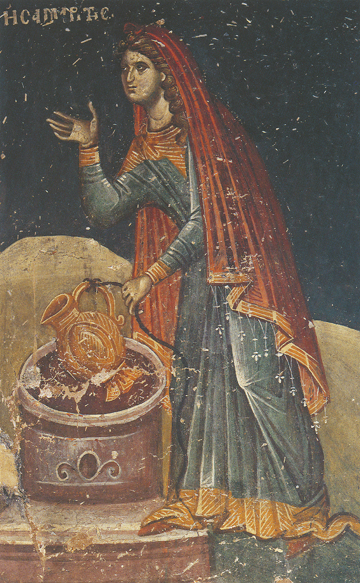
photini3

She encountered Christ personally during his ministry. The Gospel of John tells us about his meeting her at the well. During this encounter, Christ gently called her out for sexual sin: living with a man who was not her husband, and having five husbands before. She experienced an immediate conversion upon speaking with Christ and went back to her village to tell everyone about this particular trip to the well.

My patroness, St. Photini, is a familiar figure across all Christian traditions, though most know her simply as the woman at the well. When I was in the process of converting to my current Christian tradition, I felt her pulling me like a magnet. She appeared to me in my dreams, and clearly as I can now see Lindsey on the other side of the living room, I saw St. Photini sitting at the well with her jar waiting for Christ, or perhaps waiting for me. She was beckoning me to draw near. When I made the decision that she would be my saint, I felt as though I was answering an unexpected phone call from a not-so-close-yet-still-friend sort of person from my high school days. She hadn’t even made the short list of saints I’d been considering. As I shared all this with friends and acquaintances who were part of my soon-to-be-new Christian tradition, few were surprised that I had chosen St. Photini. However, I think many would be surprised to learn what did motivate and what did not motivate me to take her as my saint.

At the time I had transitioned from exploring this faith tradition into beginning the formal conversion process, people were full of suggestions as to which saint I should choose as my next patroness. Because keeping my patroness from my previous tradition was not an option, I was at a loss for whom to select. I felt strongly connected to St. Catherine of Alexandria, St. Mary Magdalene, and St. Monica, but I didn’t get an especially strong impression that I should choose one in particular. I listened intently as other people offered their thoughts, hoping that in a moment of epiphany I would realize something profound about myself, or about one of these great women of faith. That moment never came, but after about the fourth person I talked to I began to notice a troubling repetition. Everyone seemed stuck on St. Mary of Egypt, who hadn’t even crossed my mind because little in her story seemed relatable to my experience of life. And those who actually asked me which saints I had been considering would stop me mid-list at St. Mary Magdalene, proclaiming triumphantly, “That’s the one for you, Sarah!”

After hearing the names of these two saints repeated one after the other for weeks, I finally asked someone, “Why do you think so many people are advising that I take either St. Mary of Egypt or St. Mary Magdalene as my patroness?”

Seemingly puzzled by my lack of insight, he replied, “Because they’re both women who repented of serious sin.”

Having spent years reading and learning about the lives of the saints, I pressed further, “That’s true for many holy men and women the Church recognizes. What’s so special about St. Mary of Egypt and St. Mary Magdalene in that regard?”

He took a moment to stare at his shoes. Then, in a muted tone he spoke, “They repented and overcame their passions. They asked God to rid them of lustful desires…something like what you’re doing with celibacy.”

I walked away from this interaction without saying much more. Many people in Christian traditions feel qualified to offer armchair spiritual direction to others who identify as LGBT, and this advice tends to focus on helping LGBT people overcome sexual temptation. Most of these folks genuinely mean well and may even think they are complimenting a celibate LGBT person by comparing him or her to saints who once struggled with lust. Others might think they are performing a work of mercy by offering unsolicited warnings to LGBT Christians about inappropriate sexual behavior. But intentions notwithstanding, frequently these bits of guidance do more to induce feelings of shame than to help in any real way. In my experience, they give Christians and non-Christians alike a reason to believe that, “Don’t have sex!” is the only bit of wisdom and “love” the Church is willing to offer LGBT people.

Of all things I wish straight people within my Christian tradition knew about LGBT people, the fact that we aren’t just loose cannons full of insatiable sexual desire tops the list. Some weeks at my own parish when I hear bombastic claims at coffee hour about how gay people are “sexually perverting and destroying everything that’s good about America,” I ache for the opportunity to share that one’s sexual orientation is not an indicator of political views, level of sexual activity, or morality in general. I want to help people understand that for LGBT Christians, identifying with one or more of those letters does not necessarily have anything to do with what’s happening between the bedsheets—rather, it involves how one relates to others, to the world, and even to God.

I question the appropriateness of assuming that an LGBT person struggles primarily—or at all—with sexual temptation. To be sure, living up to the examples set by any of the saints is an extraordinary challenge, and having a deep sense of connectedness with these holy men and women is a great privilege. But this doesn’t change the fact that I find it painful (not to mention unhelpful) to receive counsel again and again that the best role model for taming with my own passions is a woman who was once so licentious that she wouldn’t even accept payment for prostitution.

Eventually when I did decide upon St. Photini as my patroness, the well-meaning folks who had been giving me feedback reacted positively. I think it’s likely that many who affirmed my selection felt comfortable knowing that I had chosen a saint who had repented of sexual sin. In the weeks leading up to my reception, I heard a lot of, “Ah, yes, St. Photini…the woman at the well who lived with a man she had not married, and had married five men before him.” What I didn’t hear much about was the incredible life she lived as an evangelist—the very reason I had begun to feel drawn to her after she had appeared in my dreams. My straight brothers and sisters did not have much to say about how she was baptized “the enlightened one” by the apostles, converted seven members of her family, and led all of them in spreading the good news of Christ. No one mentioned that she preached and led many others to know Christ, spat in Emperor Nero’s face when he asked her to renounce her faith, and died a martyr after being thrown down a well.

Everyone seemed glad for my awareness of St. Photini’s life pre-conversion and experience of repentance, but to this day, only two other people in my Christian tradition have ever asked me, “Why did you choose her?” I’m still learning the full answer to that question—I believe that in many cases, the saints call out to us rather than the other way around. But I hope the next time somebody inquires, it will open the door for a long, meaningful conversation about something other than lustful desires.

Comment Policy: Please remember that we, and all others commenting on this blog, are people. Practice kindness. Practice generosity. Practice asking questions. Practice showing love. Practice being human. If your comment is rude, it will be deleted. If you are constantly negative, argumentative, or bullish, you will not be able to comment anymore. We are the sole moderators of the combox.