On Feeling Betrayed

A reflection by Sarah

Everyone experiences betrayal at one time or another. It’s something we have to accept as part of the fallen world in which we exist. Sometimes people betray others intentionally; at other times, people inadvertently and carelessly betray one another. But regardless of the betrayer’s intentions, it can be very difficult to recover from the resulting harm.

Like most people, I’ve experienced betrayal in relationships. Heart-wrenching is the only term I know to describe how I felt upon learning that one of my exes had been having affairs with men and women behind my back in two different parts of the country. This feeling magnified when she decided to betray me still further by assassinating my character to our mutual friends during and after our breakup. Everyone has these kinds of stories. Nearly all adults can provide at least one tale of a relationship gone sour. But in addition to experiencing betrayal at the hands of specific friends, loved ones, and acquaintances, we can also feel betrayed by groups of people. While it’s possible to distance oneself from individuals, it’s not always possible to seek distance from certain groups, especially when you are part of those groups no matter how challenging it may be to engage with others on the inside. As a celibate, LGBT, Christian who is one-half of a celibate, LGBT couple, I find myself in a perpetual struggle with feeling betrayed by both conservative Christianity and the LGBT community. Quite often I get the impression that on the whole, neither group is willing to acknowledge my existence.

It’s probably not surprising to hear that as an LGBT person, I have felt marginalized in the Church, both in my current Christian tradition and in my former Christian tradition. I’ve been a Christian my entire life, and with the exception of some time I spent exploring more progressive Christian thought in college and early in graduate school, I have always been part of a conservative tradition of one kind or another. Over time as I’ve journeyed within traditional Christianity, I have developed a deep and abiding peace where I feel content, fulfilled, and (in the most positive sense) challenged by the Church’s wisdom. However, I cannot shake the feeling that there is nothing I can do to reconcile my faith and sexuality adequately in the eyes of conservative Christianity. There will always be someone who tells me, “Don’t do it this way. Do it that way.” There will always be a person who finds fault with my language, my process, and my way of life.

At one point in my former Christian tradition, I shared with a close friend that I was a lesbian thinking she would be supportive, and might even be willing to walk with me as I was navigating the tough questions of sexual ethics. Her immediate response was, “Don’t say that too quickly. People can always change.” For many dedicated straight Christians, it seems that an LGBT person’s embracing a celibate vocation will never be good enough. No matter what that person does, it seems that there will always be others ready to shake  fingers and pronounce, “There’s no such thing as a gay Christian.” If a person displays any willingness to use language of the LGBT community, then he or she is immediately suspect as a rabble rouser out to upend the Church.

Furthermore, many people with the conservative Church have no appreciation for how their words might affect LGBT Christians. I’ve experienced instance after instance of people getting away with incredibly hurtful and damaging comments, even when I have tried to express, “What you just said about gay people being child molesters is untrue and unnecessary.” As I have sought redress for comments people within the Church have made to me and others, more often than not the ball has been thrown back in my court because according to the majority of priests I’ve known, I must have done something morally questionable that invited the hostile remark. I must have said something that gave people legitimate cause to wonder about my willingness to live a holy life.

Within many conservative church settings, I’ve interacted with people who have fought tooth and nail to block any sort of legal recognition for LGBT people. These people have positioned themselves as “defending marriage” without realizing that much of what they are advocating has nothing to do with the definition of marriage. I have heard Christians argue that LGBT people should not have access to housing or should not be able to find jobs. In recent years, some of the more egregious examples have gone out of fashion and, as far as society is concerned, are now relegated to the “only true bigots believe that” category of ideas. However, I’ve noticed that the same folks I knew ten years ago who were willing to wage war over the possibility that LGBT couples might be able to have legally recognized relationships of any kind are the same folks who are now touting the possibility of civil partnerships as an alternative to gay marriage. From where I’ve sat on the sidelines of much of the marriage equality battle, I can’t help but observe that on some level, reactions from conservative Christian churches have given significant steam to the marriage equality movement. Perhaps the most profound way I feel betrayed by conservative Christianity is that, by all appearances, it has devoted so much energy to painting me into a legal corner with as few options as possible for meeting significant needs.

But as much as I’ve experienced a sense of betrayal within the Church, I have experienced just as much alienation and disappointment within the LGBT community. For starters, many LGBT people have no place for those who are intentionally celibate. Celibacy is cast as an oddity at best and a sign of sexual dysfunction or self-hatred at worst. I’ve experienced consistent pressure from the LGBT community (both the secular and liberal Christian factions) to be sexually active. This pressure significantly delayed my readiness to embrace my own vocation, even though I felt called to celibacy comparatively early in life. Other LGBT folks I’ve known from different contexts in my young adulthood have been quick to tell me that my experience of life is not possible, and I shouldn’t talk about my relationship with Lindsey in terms of celibacy because others have been forced into celibacy against their will. People have gone as far as bluntly commanding me to shut up because, despite our total renouncement of ex-gay ideology, Lindsey’s and my story reminds them too much of past trauma associated with celibacy. By that same logic, would it be appropriate to suggest that non-celibate couples shouldn’t get to talk about their relationships out of respect for those who have been traumatized by sexual activity…or even by marriage?

Outside of the explicitly Christian subset, I have always sensed the presence of a strong animosity towards organized religion within the LGBT community. For a community that sees itself as accepting of just about every kind of diversity, I’ve found that very few LGBT circles include space for people who practice Christianity, particularly of a traditional variety. Very soon after I moved to a new city for graduate school, I realized that a local gay bar was the only place I could go to find other people who shared some of my experiences. Since I lived only a couple of blocks away, I went regularly and tried to get involved in various lesbian social groups. However, as soon as the other women learned I was a graduate student in theology, a significant majority would stare at me–to borrow Jean Shepherd’s line from A Christmas Story–“as though I had lobsters crawling out of my ears.” I became accustomed to receiving questions like, “How can you study something that is so oppressive?” and, “Why did you sign up for that graduate program? Vestiges of internalized homophobia?” There was joking among some of my lesbian friends that I would become a nun, enter into an illicit lesbian relationship with another nun from the convent, and eventually ride off with her like Thelma and Louise, throwing caution to the wind.

And for all of its distrust of organized religion, the LGBT community has surprising bandwidth as it relates to organized politics. There seems to be an assumption that all of us want to be activists and are waiting for every opportunity to flex the community’s political muscle. Last year, Lindsey and I experienced what we perceived as betrayal by someone who was either part of the LGBT community or a strong ally. I had posted on my personal Facebook account about our being treated in a way that I regarded as discriminatory, and one of my Facebook friends decided to forward my name and email address to various media outlets without my consent. I began to receive contacts. As Lindsey and I discussed how to handle the situation, we made some decisions that might not have been the best for protecting our privacy, but we tried to be fair to us and to the party that had caused the discrimination in the first place. We received all sorts of criticism from members of the LGBT community about how we chose to treat the party that had wronged us. Several people asserted that we “owed it to the LGBT community” to broadcast the story in as many ways as possible. While we did get great support from many of our close friends, strangers from within the LGBT community cared more about leveraging our story for political purposes than about how the incident had impacted our lives. And of course, there was no interest in how our faith informed our choices as we navigated the situation.

Let’s not forget the marriage equality issue either. A few years ago, I encountered significant diversity amongst LGBT people concerning views on marriage. Some friends thought the fight for marriage equality was stupid because they viewed marriage as a patriarchal institution that could not be redeemed. Others had different reasons for being critical of the marriage equality movement, but those thoughts were usually heard and validated (unless they were religious). However, today–at least in my circles–things look very different. Any criticism of the marriage equality movement, even if it comes from a place of believing that some LGBT people should be able to marry, gets met with hostility.

Sometimes it’s absolutely exhausting to be deeply connected to two worlds where I’m constantly hearing messages about how and who I ought to be. As I’ve gotten closer to 30, I’ve become comfortable asserting, “I am who I am. What you see is what you get. And if you don’t like it, tough.” I’m not going to change who I am just to appease the sensibilities of a conservative Christian who thinks I’m the scourge of society or an LGBT person who says I’m not a real lesbian. But a tough exterior doesn’t change the fact I’ve felt so deeply betrayed by both communities, and I show a marked hesitation each time I interact with either. It has been made abundantly clear to me that both conservative Christianity and the LGBT community would rather assert that people like me do not exist.  The LGBT community would welcome me with open arms, until someone learns that I am celibate and I become the target of ridicule and pointed criticism. As for the conservative Christian community, my sense of betrayal stems from being excluded from the people of God. And when I consider how these different betrayals have manifested in my own life, I’m not surprised that many LGBT Christians have made choices to distance themselves from the Church, the LGBT community, or both.

Comment Policy: Please remember that we, and all others commenting on this blog, are people. Practice kindness. Practice generosity. Practice asking questions. Practice showing love. Practice being human. If your comment is rude, it will be deleted. If you are constantly negative, argumentative, or bullish, you will not be able to comment anymore. We are the sole moderators of the combox.
Redefining Sexual Ethics Redefines Celibacy

Today, we are honored to share a guest post from our friend Alison, another celibate member of the LGBT Christian community. Periodically, we hope to share the stories of other LGBT celibates here because we believe that all stories are valuable and worthy of being told. Each of our guest posters will have different experiences of celibacy, Christianity, sexual ethics, and life in general. That means not everything contained in every guest post will mirror our own thoughts, opinions, theology, and life experience. We believe that diversity is a beautiful part of the divine mystery, and are eager to learn more from others as they graciously share their stories with us. If you are a celibate LGBT Christian and would be interested in sharing your story with us at A Queer Calling, feel free to Contact Us.

A reflection by Alison

I was asked several months ago, “As a lesbian, why are you embracing traditional sexual ethics? Why aren’t you just a becoming a nun in the Episcopal Church?” I spent 2 years trying to be a celibate in the Episcopal church even though I was called to a more traditional denomination. Every time a conflict arose between me and the Episcopal Church, I ended up losing a deeply held notion about ethics, gender, and sexuality, and being pushed more toward Tradition. There has been a major shift in my entire way of thinking in the past few years, and when I look back on the path from there to here, I realize I would have to write volumes of text and reveal embarrassing details to guide just a few people through the same path. My answer to the question will be limited in space, education, and experience. What I can say, even at this point, is that celibacy is not merely the lack of sexual actions I take. Being a celibate person of progressive sexual ethics is totally different than being a celibate person of traditional sexual ethics.

For one thing, progressive sexual ethics tend to look at celibacy as a layover; a time of self-discovery and healing between sexual relationships. When it is not viewed as a casual commitment, celibacy is viewed as a tool. For example, it allows room for career development or charitable work. I do not see celibacy that way. Celibacy doesn’t serve me, it completes me by furthering my worship of God. Being called, for me, is a lot like falling in love. That love is only getting stronger, deeper, and wiser. Traditional celibacy, and all the theology under the surface, has become something to which I want to commit. I want this celibacy to become ingrained on my heart and life.

Traditional celibacy flows from deeper theologies. One root of the traditional sexual ethic sees all human beings as icons, as living images of God, because we are. 1 Genesis tells us that we were created in the image of God, “Male and female He created them.” Christ was born into the world and became fully human while being fully divine. There is something sacred in the physical nature of humanness, even in our fallen state. Our bodies, our sexuality, are also sacred. Editing the sexual ethics handed down to us by the people who walked with and ate with Christ is like editing the Gospel. There are times it should be done (i.e. translation into new languages) but it should be done in unity with the rest of the Church and Tradition. The progressive sexual ethic may contain theology of the body’s sacredness, but it removes the teaching from the surrounding teachings that flow into it. It cuts that particular teaching off from the desert mothers and fathers and other early saints who lived it out, and it ends up contradicting them again and again.

When I was working in scientific research, I remember listening to professors speak about their areas of expertise, and thinking, “There is no replacement for decades of 80-hour-weeks working on something.” No matter how bright you are, no matter what important fragment of knowledge you uncover, you are no match for experience. You are no match for your elders, who have seen and participated in the battles for truth and understanding since before you were born. I am no match for the Church. My ideas matter, but only in the sense that a child must learn to add before she can learn calculus. At the same time, there are false teachings and teachers everywhere. Sometimes you don’t know you’re following a false teacher for too long, and sometimes you never find out. For me, the test is unity. Unity with the past, unity amongst the community, unity with something ineffable, unselfish, and all-loving.

I was recently blessed to read a few texts written by medieval nuns. They seemed to understand the word “virginity” as a goal to aspire to, not just a physical aspect of their bodies, but a grace for which they should fight. I was shocked at how widespread this concept of virginity was. In the religion in which I grew up, that was not the view of virginity. Virginity was state of inaction. If you transgress, you are worthless. They gave symbolic lessons meant to inspire deep disgust for the lack of physical virginity. Yet, for these medieval nuns, many of whom never indulged in physical sexual activity, virginity was something they had not yet achieved. There was no disgust for sexual activity–that was merely a path to holiness they were not following. This teaching is in total agreement with the Tradition of the early Church regarding sexual ethics, but the teachings about virginity in the faith I grew up in are not. If I apply the unity test, a sexual purity lesson comparing one group of human beings (those who have had sex) to chewed-up food fails miserably.

When I converted to Christianity, I did so in the most progressive denomination available, and I still miss that church family. I still go to funerals and weddings at that church. I still care deeply about their lives, and I still desperately want their approval, just like the disaster of a teenager who walked through their doors so many years ago. That Church was the first place I ever felt loved, that church taught me everything I know about compassion, that Church was where I learned to accept the existence of a loving God. I was sitting in that Church in prayer when I was first called to be a nun. For me, love couldn’t look like, “Just do whatever you want sweetie!” because I was in rough shape. My parents were abusive, and by middle school, I was leaving the house in the morning before they woke up, and coming home after they went to sleep. I was left to raise myself with absolutely minimal interference. Parenting meant providing a place to sleep, shower, and load up on food between days. “Just do whatever,” is neglect, and I was all too familiar with it. The good people of this progressive church knew that too. One time, a man I’ll describe as “my uncle,” chastised me for not wearing my coat on a cold day. It was the first time I was corrected in a loving manner by someone who was not a teacher. My uncle cared that I was cold, he cared about me more than I did, and he did something about it.

Most of the members of this church were from extremely traditional backgrounds, and I have always wondered, if their churches had done a better job of figuring out Christian formation for gay and lesbian people, would they have ever left? I know several of the ex-Roman Catholic nuns and priests would have stayed if they hadn’t been pushed out for merely being gay or lesbian. Many people in this church talked about their attempts to embrace celibacy and being rejected anyway, or because of a slip-up. The ex-gay ministries have poisoned the water of nearly every denomination with conservative sexual ethics, turning this beautiful concept of virginity as a grace of the Holy Spirit into the same legalistic shaming with which I grew up. The religion I grew up in has satanic and pagan leanings. I view any lessons that inspire shame or vanity as profoundly unChristian.

At the same time, I can’t help but see that the impact of “do whatever” theology is very similar. “Do whatever” distracts us from aspiring to the grace of virginity, from unity with the Church and with God, by turning our focus inward. This focus forces us to constantly discipline ourselves, and figure out, “What do I need?” on our own. I am still a child in comparison to the church, She is my mother, and I would never ask Her to neglect me the way my parents did in my teenage years. I expect Her to chastise me lovingly, like my uncle.

I don’t know where this leaves my gay and lesbian brothers and sisters who are not called to celibacy yet (sidenote: marital chastity, too, is a path to total chastity, just not yet). All I can say is, even with a lifetime of work, I am going to fall short of chastity as a grace of the Holy Spirit. Even as a celibate, there are elements of the Church who declare that I am a sinner merely because I will not lie about my sexual orientation. Despite many reformed whores among the saints, there are those who see my past transgressions, and desire to block my reception into the Church. The Church has room for improvement, and so do I. Maybe we should look at unity the same way the medieval nuns looked at virginity. It is a grace of the Holy Spirit, one we are working toward and haven’t yet achieved. Like chastity, it’s not a battle I’m willing to give up on.

Comment Policy: Please remember that we, and all others commenting on this blog, are people. Practice kindness. Practice generosity. Practice asking questions. Practice showing love. Practice being human. If your comment is rude, it will be deleted. If you are constantly negative, argumentative, or bullish, you will not be able to comment anymore. We are the sole moderators of the combox.

In Which the Woman at the Well Appears in My Dreams (or, When Armchair Spiritual Direction Fails)

A reflection by Sarah

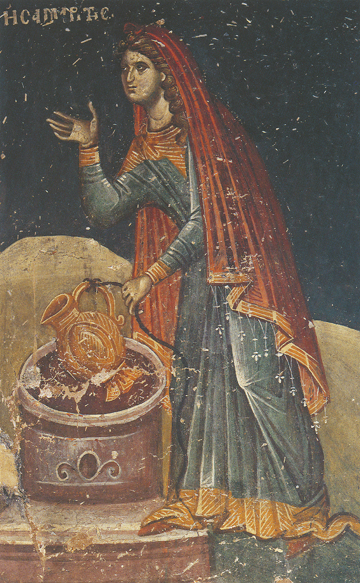
photini3

She encountered Christ personally during his ministry. The Gospel of John tells us about his meeting her at the well. During this encounter, Christ gently called her out for sexual sin: living with a man who was not her husband, and having five husbands before. She experienced an immediate conversion upon speaking with Christ and went back to her village to tell everyone about this particular trip to the well.

My patroness, St. Photini, is a familiar figure across all Christian traditions, though most know her simply as the woman at the well. When I was in the process of converting to my current Christian tradition, I felt her pulling me like a magnet. She appeared to me in my dreams, and clearly as I can now see Lindsey on the other side of the living room, I saw St. Photini sitting at the well with her jar waiting for Christ, or perhaps waiting for me. She was beckoning me to draw near. When I made the decision that she would be my saint, I felt as though I was answering an unexpected phone call from a not-so-close-yet-still-friend sort of person from my high school days. She hadn’t even made the short list of saints I’d been considering. As I shared all this with friends and acquaintances who were part of my soon-to-be-new Christian tradition, few were surprised that I had chosen St. Photini. However, I think many would be surprised to learn what did motivate and what did not motivate me to take her as my saint.

At the time I had transitioned from exploring this faith tradition into beginning the formal conversion process, people were full of suggestions as to which saint I should choose as my next patroness. Because keeping my patroness from my previous tradition was not an option, I was at a loss for whom to select. I felt strongly connected to St. Catherine of Alexandria, St. Mary Magdalene, and St. Monica, but I didn’t get an especially strong impression that I should choose one in particular. I listened intently as other people offered their thoughts, hoping that in a moment of epiphany I would realize something profound about myself, or about one of these great women of faith. That moment never came, but after about the fourth person I talked to I began to notice a troubling repetition. Everyone seemed stuck on St. Mary of Egypt, who hadn’t even crossed my mind because little in her story seemed relatable to my experience of life. And those who actually asked me which saints I had been considering would stop me mid-list at St. Mary Magdalene, proclaiming triumphantly, “That’s the one for you, Sarah!”

After hearing the names of these two saints repeated one after the other for weeks, I finally asked someone, “Why do you think so many people are advising that I take either St. Mary of Egypt or St. Mary Magdalene as my patroness?”

Seemingly puzzled by my lack of insight, he replied, “Because they’re both women who repented of serious sin.”

Having spent years reading and learning about the lives of the saints, I pressed further, “That’s true for many holy men and women the Church recognizes. What’s so special about St. Mary of Egypt and St. Mary Magdalene in that regard?”

He took a moment to stare at his shoes. Then, in a muted tone he spoke, “They repented and overcame their passions. They asked God to rid them of lustful desires…something like what you’re doing with celibacy.”

I walked away from this interaction without saying much more. Many people in Christian traditions feel qualified to offer armchair spiritual direction to others who identify as LGBT, and this advice tends to focus on helping LGBT people overcome sexual temptation. Most of these folks genuinely mean well and may even think they are complimenting a celibate LGBT person by comparing him or her to saints who once struggled with lust. Others might think they are performing a work of mercy by offering unsolicited warnings to LGBT Christians about inappropriate sexual behavior. But intentions notwithstanding, frequently these bits of guidance do more to induce feelings of shame than to help in any real way. In my experience, they give Christians and non-Christians alike a reason to believe that, “Don’t have sex!” is the only bit of wisdom and “love” the Church is willing to offer LGBT people.

Of all things I wish straight people within my Christian tradition knew about LGBT people, the fact that we aren’t just loose cannons full of insatiable sexual desire tops the list. Some weeks at my own parish when I hear bombastic claims at coffee hour about how gay people are “sexually perverting and destroying everything that’s good about America,” I ache for the opportunity to share that one’s sexual orientation is not an indicator of political views, level of sexual activity, or morality in general. I want to help people understand that for LGBT Christians, identifying with one or more of those letters does not necessarily have anything to do with what’s happening between the bedsheets—rather, it involves how one relates to others, to the world, and even to God.

I question the appropriateness of assuming that an LGBT person struggles primarily—or at all—with sexual temptation. To be sure, living up to the examples set by any of the saints is an extraordinary challenge, and having a deep sense of connectedness with these holy men and women is a great privilege. But this doesn’t change the fact that I find it painful (not to mention unhelpful) to receive counsel again and again that the best role model for taming with my own passions is a woman who was once so licentious that she wouldn’t even accept payment for prostitution.

Eventually when I did decide upon St. Photini as my patroness, the well-meaning folks who had been giving me feedback reacted positively. I think it’s likely that many who affirmed my selection felt comfortable knowing that I had chosen a saint who had repented of sexual sin. In the weeks leading up to my reception, I heard a lot of, “Ah, yes, St. Photini…the woman at the well who lived with a man she had not married, and had married five men before him.” What I didn’t hear much about was the incredible life she lived as an evangelist—the very reason I had begun to feel drawn to her after she had appeared in my dreams. My straight brothers and sisters did not have much to say about how she was baptized “the enlightened one” by the apostles, converted seven members of her family, and led all of them in spreading the good news of Christ. No one mentioned that she preached and led many others to know Christ, spat in Emperor Nero’s face when he asked her to renounce her faith, and died a martyr after being thrown down a well.

Everyone seemed glad for my awareness of St. Photini’s life pre-conversion and experience of repentance, but to this day, only two other people in my Christian tradition have ever asked me, “Why did you choose her?” I’m still learning the full answer to that question—I believe that in many cases, the saints call out to us rather than the other way around. But I hope the next time somebody inquires, it will open the door for a long, meaningful conversation about something other than lustful desires.

Comment Policy: Please remember that we, and all others commenting on this blog, are people. Practice kindness. Practice generosity. Practice asking questions. Practice showing love. Practice being human. If your comment is rude, it will be deleted. If you are constantly negative, argumentative, or bullish, you will not be able to comment anymore. We are the sole moderators of the combox.

A Review of Generous Spaciousness by Wendy VanderWal-Gritter

We feel honored today for the opportunity to review Generous Spaciousness: Responding to Gay Christians in the Church, written by our friend Wendy VanderWal-Gritter. Since listening to her speak at the 2014 Gay Christian Network Conference, both of us have been anxious to get our hands on this book as soon as possible after its publication. On a personal level, we are immensely grateful for the generous spaciousness she has extended to us as we discern our particular queer calling, and are excited to offer our readers a preview of the positive contributions this book makes to the ongoing LGBT Christian conversation. We have spent several hours reading and rereading her work as thoroughly as possible so that way may give our most honest assessment. Along with the positives, we hope also to offer our readers the opportunity for further discussion on points where Generous Spaciousness seems to offer a bit more space for non-celibate LGBT Christians than for their celibate brothers and sisters.

As with the first book review we published, our review of Generous Spaciousness will focus on two primary questions: What does this book have to say to LGBT Christians who are living celibacy or exploring the possibility of celibate vocations? How does this book contribute to conversation about celibacy as a way of life that LGBT Christians might choose?

We think it is important to note that VanderWal-Gritter’s work has been informed by many years of providing pastoral care to Christians asking difficult questions about sexual orientation and gender identity. Her extensive experience shines through brilliantly in Generous Spaciousness. We are confident that LGBT Christians across the spectrum of ideologies on sexual ethics will find this book beneficial in one way or another. Specifically pertaining to celibate LGBT Christians, it has three major strengths:

First, Generous Spaciousness affirms LGBT Christians as part of the Church as opposed to a mission field for the Church to evangelize. We see this contribution as especially significant, but simultaneously we find it troubling that making such a simple statement is still necessary in Christianity as we know it today. This work clearly comes from a place of recognizing the faithfulness and dedication of LGBT Christians, seeing no reason to infer that a person’s sexual orientation or gender identity must automatically subdue his or her dedication to Christ. As in the example below, Generous Spaciousness shows profound appreciation for the struggles LGBT Christians have faced in order to remain connected to faith communities and to a personal sense of faith when those communities have failed to support their spiritual development:

“The Barna Group (a Christian research and polling company) found that over 70 percent of gay adults identify some connection with the Christian faith. And 58 percent indicate a personal relationship with Christ that is still important to them. But 42 percent were unchurched, which is significantly higher than heterosexual respondents (28 percent were unchurched). It has been said that the gay community is full of evangelical Christians who have been shown the back door of fellowship by the Church” (pg. 78).

We cannot speak highly enough to the profound empathy that is present throughout this book. Both celibate and non-celibate LGBT Christians will be gladdened to hear such strong advocacy for straight members of Christian faith communities to see people of all sexual orientations and gender identities as part of the Church.

Second, Generous Spaciousness speaks to the value of moving beyond dichotomies when ministering to real people. Most other books we’ve read on questions of how best to include LGBT members within Christian churches focus chiefly on gay marriage, arguing strongly for or against adoption of rituals for the blessing of same-sex unions. We were delighted to see that this book does not put a horse in that race. Instead, it encourages all Christians to move beyond scripts when asking and exploring questions about sexual orientation and gender identity, and especially when encountering young people who are dealing with these issues for the very first time.

Generous Spaciousness rightly calls attention to the fact that young people have already formulated statements about the acceptability of being LGBT and Christian, many believing that one cannot be both and must choose between the two. Further, it suggests more helpful ways of thinking about questions of sexuality and gender identity that move the conversation beyond mandates and towards core issues of Christian discipleship. In Chapter 5, VanderWal-Gritter offers four examples of “life-giving stories that could be part of the thought and heart process of the students in our congregations who are navigating their faith and sexuality:”

* “My family, pastor, and church support me in being honest about my confusion, questions, and experiences of sexual identity.”

* “As a gay person, I have options to explore as I decide how to live my life in congruence with my beliefs and values.”

* “I know that people in my family and church will love me and welcome me in the future–even if we have differences in our perspectives and ideas about homosexuality.”

* “I can be open to whatever God will do in my life and be confident that I will have the opportunity to love and be loved” (pg. 89)

As we read this section of the book, it struck us that each of these life-giving stories could be just as relevant for a person considering celibacy as for a person considering a non-celibate way of life. LGBT Christians who ultimately decide to commit to celibacy could benefit from more supportive parents, pastors, and communities amidst confusion along the road to that decision. Those leaning towards celibacy may also find comfort in knowing that there are multiple options for celibate vocations, including monasticism, celibate partnership, lay secular institutes, and life as a celibate single person. It is also true that celibates and non-celibates alike often encounter differences in perspective with their families and churches regarding homosexuality. A committed celibate who finds a label like “gay” or “transgender” meaningful might belong to a family and church where most people believe that one should not even use a sexual orientation or gender identity label, or alternatively might be part of a family or church where others take a more progressive stance on sexual ethics. In either case, knowing that one is loved despite this difference can be meaningful. It can be greatly comforting for a person considering celibacy to be able to trust that God will lead him or her toward loving relationships with other people. Though many readers will probably see the four items on VanderWal-Gritter’s list primarily as affirmations of non-celibate vocational pathways, we were impressed to see that these and many other pointers offered in this book are also relevant for LGBT Christians who have chosen or may eventually choose celibacy.

Third, Generous Spaciousness articulates a vision for “staying alive to hopefulness” that is inclusive of LGBT Christians who intend to pursue celibacy. Acknowledging one’s sexual orientation and gender identity can be a difficult process to navigate, especially at the outset of the journey. We’ve read a lot of tips for people trying to come out that focus on an end goal of celebrating one’s LGBT identity and engaging in various kinds of sexual relationships. Generous Spaciousness offers three concrete pathways that guide people towards Christ first and foremost: release of grief, reception of beauty, and cultivation of a positive vision for the future. Surprisingly, these pathways are not explicitly linked to sexual orientation or gender identity, but rather center on trying to find a vocation when one realizes oneself to be a minority. Generous Spaciousness encourages LGBT Christians to see the hopefulness of wider creation while at the same time seeking beauty within their experiences of being in a gender and/or sexual minority, noting that being LGBT should be viewed holistically:

“A gay person’s sense of sexuality ought to be viewed through the same robust lens of holistic sexuality. Connecting our relational image bearing to our sexuality invites us to consider creativity, humor, communion, and the like as expressions of our sexuality. All of these aspects of our personhood are connected to the reality that we are sexual beings” (pg. 115).

By challenging its readers to see sexuality as fundamentally about human connectedness, Generous Spaciousness offers strong guidance as to how an LGBT person might go about integrating his or her sexuality into a broader sense of self.

For all its strengths, Generous Spaciousness does have two significant weaknesses in its ability to help churches support LGBT Christians who are celibate or who are exploring celibacy. The book tries exceptionally hard to be inclusive of the experiences of all LGBT Christians. However, it seems that in detailing the evolution of ministry at New Direction from being an Exodus International member ministry for people with “unwanted same-sex attraction” to embodying a posture aligned with generous spaciousness for LGBT Christians to come to differing conclusions, the book extends a much stronger overture to LGBT Christians already in or exploring the possibility of sexually active same-sex relationships.

The first weakness is that Generous Spaciousness seems to assume celibate LGBT Christians do not need stronger affirmation of their vocations from the Church, and that the Church’s real challenge is in supporting non-celibate LGBT Christians. This might come as a surprising critique, especially given that New Direction has received praise for its ministry towards celibate LGBT Christians. Nevertheless, the book provides two exceptionally poignant examples that leave us wondering how much support celibate LGBT Christians can receive within a church community that employs a generous spaciousness approach.

At the end of Chapter 6, VanderWal-Gritter tells the story of a woman who experiences same-sex attraction but is committed to celibacy. This woman was attending a diverse church with many gay couples. The presence of gay couples “made it harder for her to stay true to her convictions. She spoke to her pastor, and he wisely suggested that she meet with one of the lesbian couples” (pg. 106). The woman committed to celibacy could affirm the authentic Christian faith of the lesbian couple, “but as she twisted the wedding ring on her hand–a symbol that God, her bridegroom, would provide for her needs–she was able to say that God had enlarged her heart” (pg. 107). At no point in this story do we hear about how another person offered the celibate woman a sense of generous spaciousness to discern her vocation in community; indeed, it seems that her pastor’s counsel was more for her to give generous spaciousness than to receive support. VanderWal-Gritter appears to support this counsel, thus overlooking the challenges faced by a person committed to a celibate vocation in a sea of people who are married or strongly exploring the possibility of marriage.

Chapter 12 explores the question of how to provide LGBT Christians with opportunities to lead and serve local congregations that frequently have firm expectations of people in leadership and pastors who struggle to communicate in a sensitive manner. VanderWal-Gritter highlights the example of a married LGBT couple looking for a church and emailing churches in an effort to discern how welcome they would be as a family. As a couple ourselves, we appreciated the presence of this example because we are all too aware of how congregations can ostracize LGBT people in their midst. While this is a great example and is important for churches to consider, it comes on the heels of twelve chapters worth of anecdotes, very few featuring a clearly identified celibate LGBT Christian struggling to be welcomed and affirmed in his or her faith community. We are familiar with the broader LGBT Christian community enough to infer that more of these stories than the obvious ones likely feature celibate people. However, since the vocational status of celibate LGBT Christians is often left unstated, Generous Spaciousness unwittingly suggests that a celibate LGBT Christian doesn’t need as much space as a non-celibate for discerning his or her distinctive vocation because he or she likely has a more traditional sexual ethic.

The second weakness is that Generous Spaciousness discusses all forms of committed relationships among LGBT Christians as though they are basically the same regardless of whether they are sexual. Throughout the book, VanderWal-Gritter uses many descriptors for relationships between LGBT people such as “same-sex relationships,” “consummated partnerships,” and “covenanted gay relationships.” Frequently, she employs these terms interchangeably in a way that suggests they apply to sexually active relationships. In the few instances where this book shows openness to the question of whether LGBT people could be in celibate relationships, the uniqueness of this type of relationship seems hidden:

“It is important to remember that love is love. And love is of God. There is much love to be given and received within the context of companionship or friendships, whether or not these relationships take on an exclusive or primary role in a person’s life and whether or not they are consummated sexually” (pg. 101).

We’ve devoted a lot of space here at A Queer Calling to discussing the uniqueness of the celibate vocation lived in partnership. For many celibate LGBT Christians, it is a difficult process to discern what celibacy can look like within a shifting landscape of vocations, and this is certainly true for others we know who are pursuing celibate relationships. At times while reading Generous Spaciousness, we felt as though we were being lumped together with LGBT couples who do not feel called to celibacy, as though the only difference between a celibate partnership and a non-celibate partnership is the absence of sex. Consider the following quote: “When we read accounts of gay, celibate Christians, deeply committed to the self-denial such commitment entails, and stories of gay Christians who are affirming of gay relationships, it can cause a great deal of confusion. Inevitably, we may find ourselves asking, ‘Who is really committed to Christ?'” (pg. 105). With these categorical divisions posed, we are left scratching our heads and wondering where we fit into the mix.

On the whole, we are grateful for Generous Spaciousness: Responding to Gay Christians in the Church. Wendy VanderWal-Gritter presents a compelling case for why generous spaciousness is needed in the first place and provides insights as to how this approach can open up life-giving vocational pathways for LGBT Christians. She offers a solid starting set of ideas for how LGBT Christians inclined towards celibacy could find strength as they grow into mature vocations. However, celibate LGBT Christians themselves need a generous spaciousness within the Church to receive support in these vocations, and we did not see those needs fully recognized within this book.

Comment Policy: Please remember that we, and all others commenting on this blog, are people. Practice kindness. Practice generosity. Practice asking questions. Practice showing love. Practice being human. If your comment is rude, it will be deleted. If you are constantly negative, argumentative, or bullish, you will not be able to comment anymore. We are the sole moderators of the combox.

Celibacy as a “Layover”

“Celibacy is a necessary holding pattern for many LGBT people who are recovering from their experiences in the ex-gay world. I’m okay with talking about this way of life with the understanding that it isn’t meant to be permanent. After you gain a few more years of life experience and become more comfortable in your identities, you’ll be able to appreciate celibacy as a stop along the way to full acceptance of yourselves as LGBT Christians.”

This isn’t an exact quote, but rather a summary of dozens of messages that regularly hit our inbox. In response to several posts we’ve written (like this one, this one, and this one), some readers have sent us messages such as the one above, and others have contacted us to request that we write on the particular misconception about celibacy implicit in these messages.

As we’ve participated in the broader LGBT Christian conversation over the years, we’ve noticed prevalence in the idea that celibacy is a “layover” along the journey to self- acceptance. Usually, this assumption will come up in discussion the very first time we even mention the c-word to folks who know we are part of the LGBT community. At this point, we’ve lost count of how many times we’ve been told some variation of: “One day, you’ll come to accept yourselves as you are and you’ll not have to be celibate anymore.” Because we and other LGBT celibates hear this message so often, we think it’s important to address it directly in a post. We believe this message is unhelpful and inappropriate for several reasons.

Before we speak to some of these specifically, we want to be clear in our acknowledgement that for some people, temporary celibacy is part of a longer process that culminates in the embrace of a progressive sexual ethic. The purpose of this post is not to deny that this experience exists or to make a judgment about LGBT people who have come to view celibacy as a “layover” rather than a permanent way of life. Our intention is to discuss the assumption that all LGBT celibates will eventually come to view celibacy in this way and move on to sexually active relationships.

Having said that, here are the top three reasons we see the “celibacy as layover” message as problematic:

It degrades singleness and various kinds of intimate relationships that are not sexual. As we’ve written about in other posts, many people see marriage and other types of sexual relationships as rites of passage from adolescence into adulthood. In some Christian circles, it almost seems that there is a marriage mandate: if you aren’t married, others believe that something must be wrong with you. Though we did not address this directly in our first post on marriage, while preparing for it we heard from people of all sexual orientations and gender identities who find this pressure to marry troubling. It seems to us that seeing LGBT self-acceptance as contingent upon openness to sexual activity is not much different from seeing a sexually active way of life as the only “normal” vocation for any person. Both messages place harmful limits on the diversity of human experience, and neither leaves room for the stories of people who find fulfillment and connectedness in monastic or lay celibate life.

It posits incorrectly that all LGBT celibates are celibate for the same reasons. One variety of life experience that debates on LGBT sexual ethics frequently ignore is that of the person who has chosen celibacy but not because of a belief that same-sex sexual activity is sinful. He or she might not feel well suited to a lifelong partnership. Perhaps he or she finds that emotionally intimate friendships and other relationships meet all his or her needs for companionship. The “celibacy as layover” message seeks to make these types of experiences into something pathological, finding internalized homophobia even if there is none. Additionally, it suggests that all LGBT celibates either experience self-hatred on a personal level or are blindly obedient to an institution that promotes contempt against the LGBT community. It leaves no space for the possibility that an LGBT person has given his or her full consent to living a celibate vocation and is answering a call from God.

It labels LGBT celibates as poor, unfortunate souls who need help to reach liberation through expression of sexuality. This is possibly the most upsetting aspect of the “celibacy as layover” message for an LGBT celibate who has chosen his or her vocation freely after significant prayer and reflection. It negates the entirety of a person’s process of coming to terms with his or her sexuality, assuming that there must be some element missing from that process if sexual activity does not become part of an LGBT person’s life. Though not always the case, we hear this notion most often from straight people. To us, that makes it even more troubling because the person offering the message is implying that he or she knows better than we do what is best for us. Every time we hear others’ opinions on how pitiful, deluded, and frightened we must be to have chosen celibacy and how much more liberated we would feel if we would just give in and have sex, we wonder about what “liberation” actually means to the person making these statements. In what sense is pressuring another human being to engage in a sexual relationship “liberating”?

The common thread amongst all uses of the “celibacy as layover” message as we’ve heard it is that it’s often posed as an affirming statement to help people integrate faith and sexuality. Once again, we do not wish to deny the experiences of LGBT people who have lived celibacy temporarily and have later adopted other ways of life. But it’s erroneous to suggest that all LGBT celibates will eventually engage in sexual activity or else spend the rest of our lives in misery. We wonder what other kinds of messages might be intended as affirming and helpful, but can actually be limiting, oppressive, or harmful to members of the LGBT community. If you have thoughts on this, please share in the comments.

Comment Policy: Please remember that we, and all others commenting on this blog, are people. Practice kindness. Practice generosity. Practice asking questions. Practice showing love. Practice being human. If your comment is rude, it will be deleted. If you are constantly negative, argumentative, or bullish, you will not be able to comment anymore. We are the sole moderators of the combox.